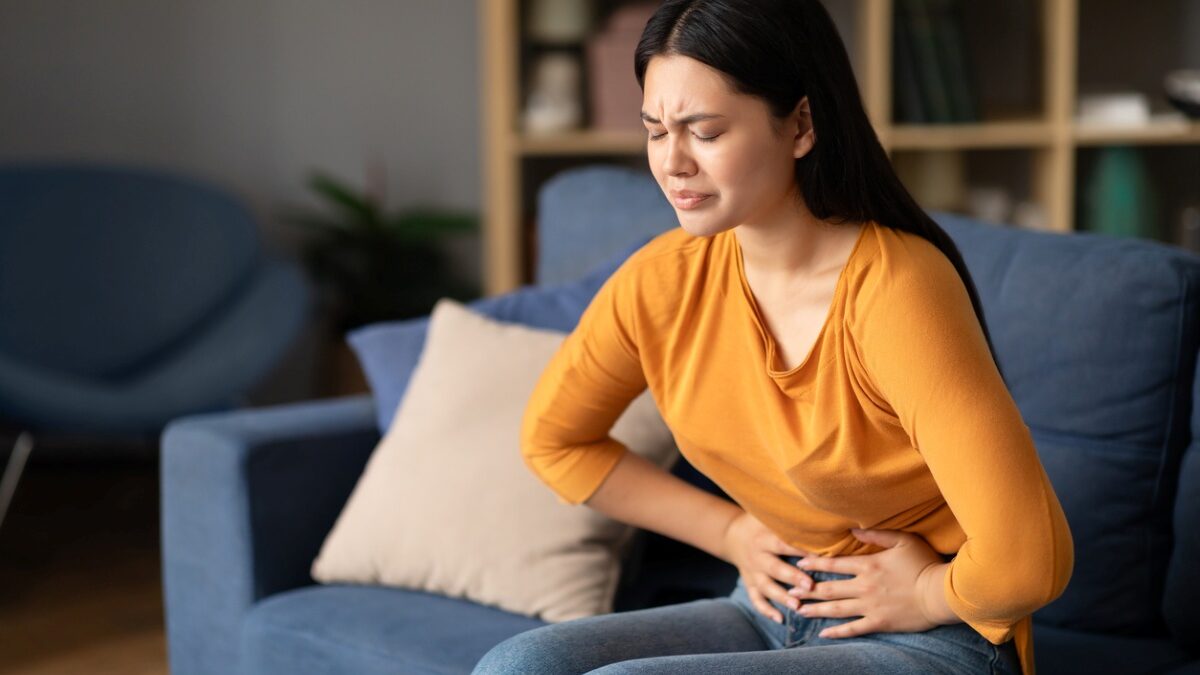
Lower abdominal pain in women can come from the digestive tract, the urinary tract, or the reproductive organs, and those systems sit close enough together that the pain often feels identical no matter which one is involved. Several of the reproductive causes are true emergencies that can worsen within hours, including ectopic pregnancy, ovarian torsion, a ruptured cyst that bleeds, and pelvic infection. Because all four can look like bad cramps or a urinary tract infection at first, they are among the most commonly delayed diagnoses in women’s health.
Sudden One-Sided Pelvic Pain: The Biggest Warning Sign
Sudden, severe pain on one side is the single most important warning sign. Menstrual cramps build gradually and spread across the lower abdomen. Pain that hits hard within minutes, stays on one side, and doubles you over is a different event.
Add nausea and vomiting to that one-sided pain and the concern rises, because the body reacts that way when an organ is twisting or bleeding rather than cramping.
Ectopic Pregnancy Symptoms and Warning Signs
An ectopic pregnancy is one that implants outside the uterus, most often in a fallopian tube. The tube cannot stretch to accommodate it, and if it ruptures, the internal bleeding can become life-threatening quickly.
The classic picture is one-sided pelvic pain with a missed or unusual period and light vaginal bleeding or spotting. Pain in the tip of the shoulder is an important and easily missed sign, caused by blood irritating the nerve under the diaphragm. Dizziness or fainting means bleeding is already significant.
Any lower abdominal pain with a positive pregnancy test needs evaluation at an emergency room near you the same day. So does pain with a late period, even if you have not tested.
Ovarian Torsion: Sudden Severe Pain on One Side
Ovarian torsion happens when an ovary twists on the ligaments that hold it, cutting off its own blood supply. It usually causes sudden intense pain on one side, often with vomiting, and the pain may ease and return as the ovary twists and untwists.
Timing determines the outcome. An ovary that loses circulation for too long cannot be saved, so this is measured in hours, not days. Torsion is more likely when a cyst is present, since the added weight makes twisting easier.
Ruptured Ovarian Cyst Symptoms and When to Worry
Ovarian cysts are common and most cause no trouble. When one ruptures, it often produces sudden sharp pain on one side, sometimes around the middle of the cycle or after sex or exercise.
Many ruptured cysts settle on their own. The reason to be seen is that some bleed significantly into the abdomen, and there is no way to tell from the outside. Increasing pain, lightheadedness, or a rapid heartbeat means the bleeding needs attention.
Pelvic Inflammatory Disease (PID) Symptoms
Pelvic inflammatory disease is an infection of the reproductive organs, usually spreading upward from the cervix. It tends to cause lower abdominal pain across both sides, fever, unusual discharge, pain during sex, and bleeding between periods.
The pain is often milder than the other conditions here, which is exactly the problem. Untreated infection can scar the fallopian tubes and lead to infertility and future ectopic pregnancies, so mild symptoms still deserve prompt treatment and, where relevant, STD testing.
When to Go to the ER for Pelvic Pain
Come in right away for any of the following:
- Sudden severe pain on one side, with or without vomiting
- Any abdominal pain with a positive pregnancy test or a missed period
- Pain with fainting, lightheadedness, or a racing heart
- Pain with fever, chills, or foul-smelling discharge
- Shoulder tip pain along with pelvic pain
- Heavy vaginal bleeding, or bleeding with severe pain
How a Pregnancy Test and Ultrasound Find the Cause
A pregnancy test comes first, because the answer changes everything that follows. A pelvic ultrasound then looks directly at the ovaries, the uterus, and the surrounding area, and it can show a twisted ovary, free fluid from bleeding, or a pregnancy sitting outside the uterus.
Blood work and urine testing help sort infection from bleeding. Because appendicitis and kidney stones produce nearly the same pain in the same place, the same period of testing and observation can rule those in or out.
Get Pelvic Pain Checked at Sugar Land ER
Cramps that are worse than your normal cramps are not automatically a bad month, and pain that feels wrong deserves an answer rather than a wait.
Sugar Land ER is open 24 hours a day, every day of the year, with a strict no-wait policy, board-certified emergency physicians, an on-site COLA-certified laboratory, and on-site imaging including ultrasound, X-ray, and CT. Check in online at ercaresugarland.com before you arrive, or call (281) 697-5250. If pain is severe or you feel faint, call 911.